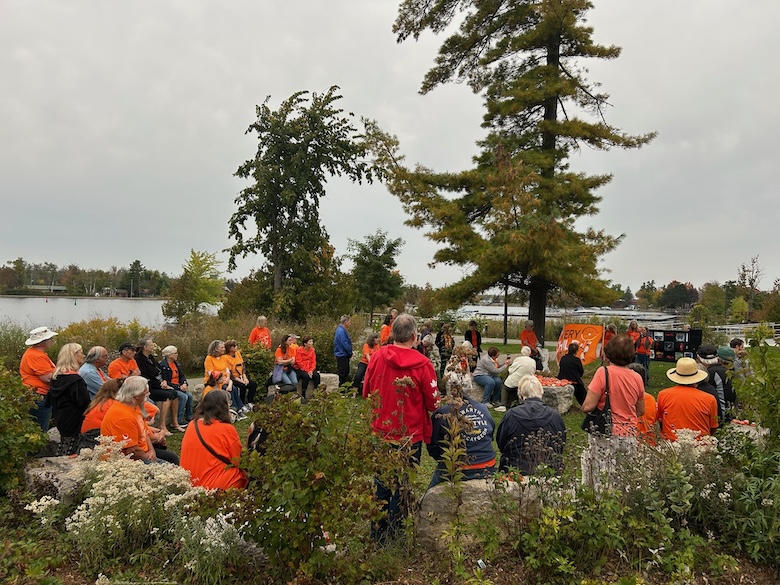
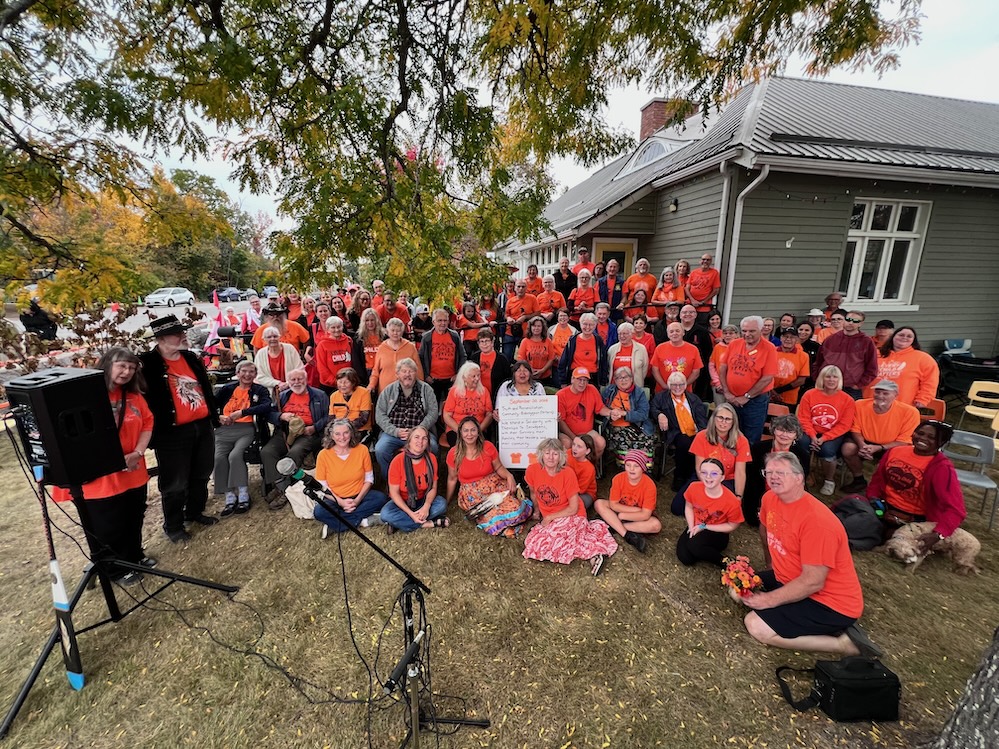
Over 120 people gathered on September 30th at the Boyd Museum and later at the Gdinuhwendimin Garden at the Beach Park to honour and remember the children and families impacted by residential schools in Canada.
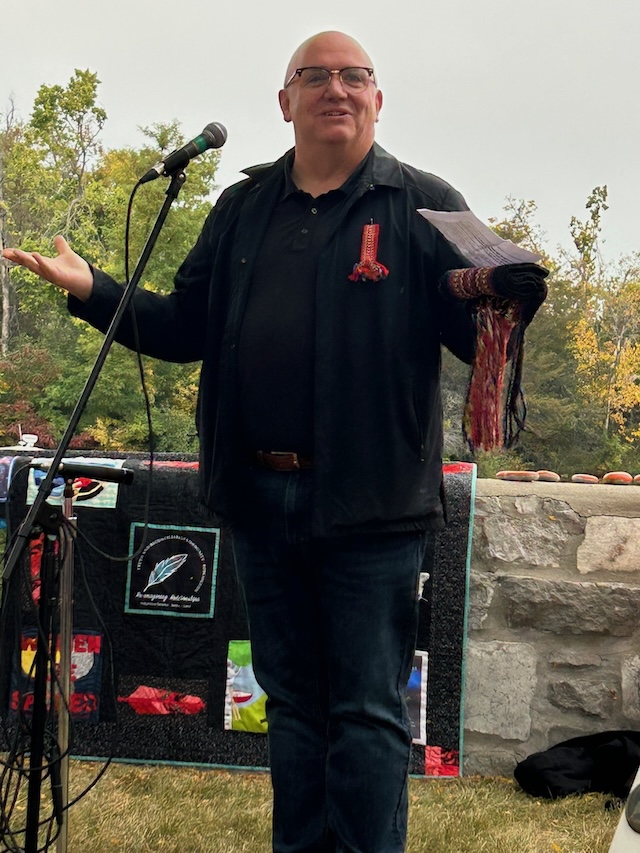
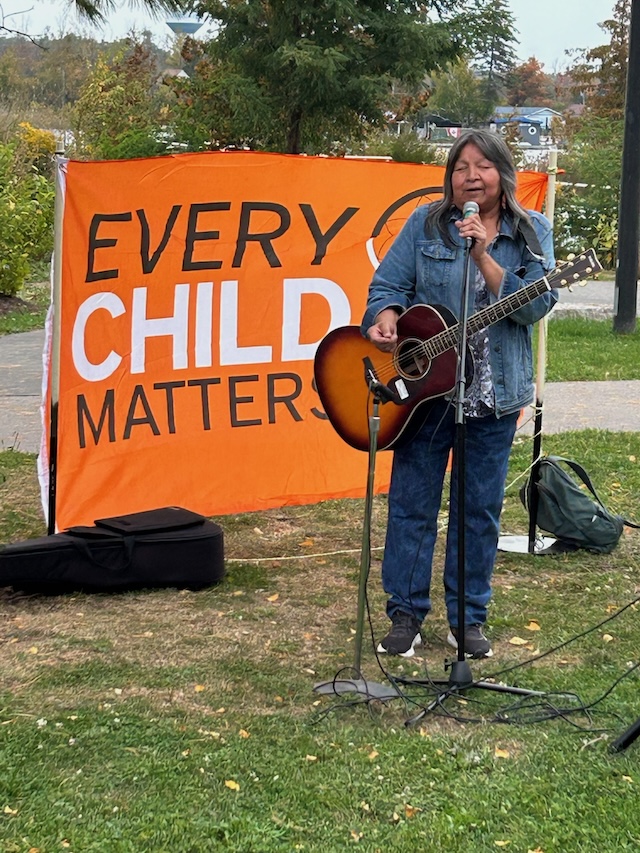
Brittany Taylor and Peggy Day of Curve Lake First Nation helped us to reflect on this day. Brittany opened with a traditional drum song and an introduction to help us think about this day, Peggy sang songs reflecting the harsh realities of this time, and Mike Perry represented the Métis Nation in adding words of reflection.
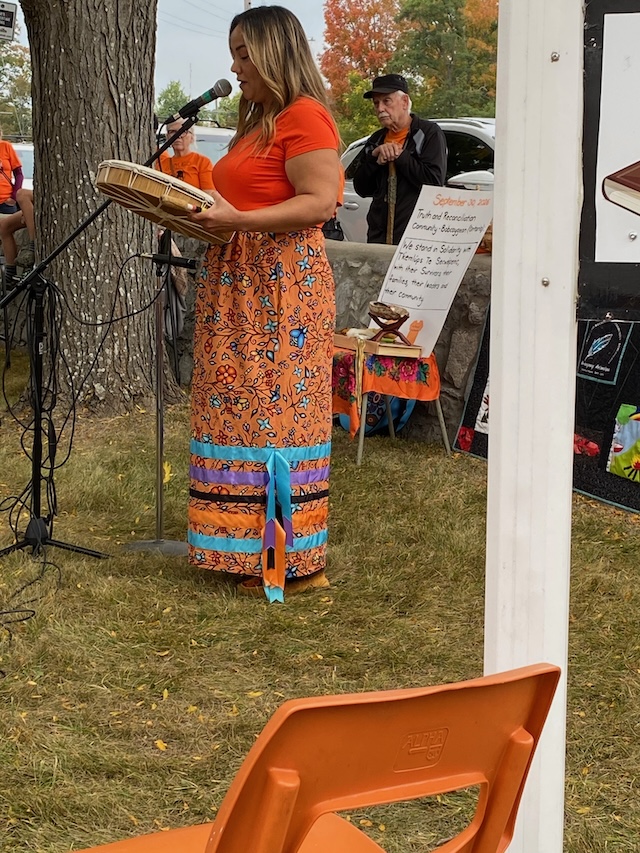
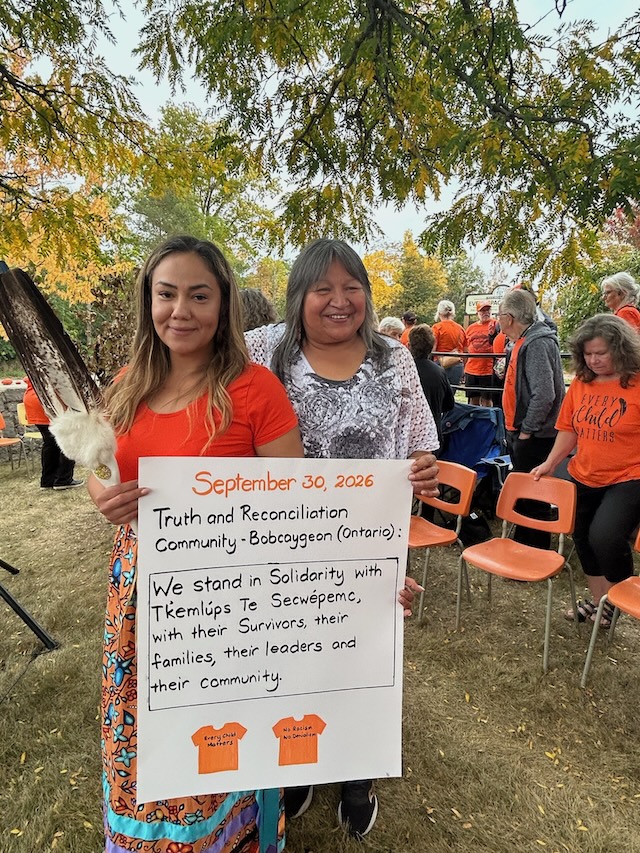
Today is not a celebration it is a day of solemn remembrance. When we wear our orange shirts, we are honouring the children who never returned home from residential schools, the survivors who carry unimaginable scars and their families and communities who continue to bear generational grief.
We must acknowledge a hard truth: the suffering that Indigenous peoples face did not end with the closure of the last residential school. It echoes through systemic inequities, the crisis of missing and murdered Indigenous women, girls, and two spirit people, and the ongoing trauma of colonization.
That is why we must emphasize that reconciliation is not just for today. September 30th is a vital anchor point for national reflection, but if our commitment to reconciliation begins and ends on this single day, it is merely performative. True reconciliation requires 365 days a year of listening, unlearning and actionable change.
The wonderful thing is that meaningful work is happening right here at home in the City of Kawartha Lakes.
If you look back to how our community has rallied, you can trace it through powerful milestones. Think of the painted rocks project at the Boyd Museum in Bobcaygeon where community members gathered to paint rocks with messages of hope, healing, respect and truth. Those painted rocks weren’t just art they were physical manifestations of a community choosing to break the silence. To come together in their shared grief.
That momentum didn’t stop there. It grew into the incredible work done by the Truth and Reconciliation Community in Bobcaygeon, leading to the creation of the Gdinuhwendimin Beach Park Garden. Working alongside community members, organizations and even local students, this space was transformed. Native plants and medicines were put into the earth, turning a neglected area into a living, breathing landscape of reflection.
A garden requires constant care, watering, weeding and patience just like any vital relationship. That garden is a living metaphor for reconciliation it reminds us that we must tend to our relationships with the land, with history and with one another if we want healing to truly take root and flourish.
People often ask, “What can I do? How can I actually be an ally?” How can I help!?”
Being an ally is not an identity badge you give yourself it is an active, ongoing choice defined by your actions. Here are a few ways you can make a change.
Read the 94 Calls to Action of the Truth and Reconciliation Commission. Learn the true history of the land you live on here in the traditional territory covered by the Williams Treaties and the homelands of the Michi Saagiig Anishinaabe. Don’t place the burden of education onto Indigenous people do the reading yourself.
Visit local Indigenous businesses, support local cultural events and engage with community resources like the Curve Lake First Nation Cultural Centre and places like the Nogojiwanong Friendship Centre.
Call out casual racism when you hear it. Talk to your friends, family and colleagues about why reconciliation matters. Allyship means using your voice when Indigenous people aren’t in the room to advocate for themselves.
The First People of Canada include many (over 630) distinct nations First Nations. Inuit and Métis are the other 2 peoples that are recognized as distinct groups with their own culture, language and history.
Mike Perry spoke with these words of inspiration.
Taanishi, all my relations.
I stand here as a grandson of Niganhijigak, from the Menominee Anishinaabeg, the People of the Wild Rice
and of François Dusome, trading furs.
I come wearing the Métis sash, the Dark Times coloured sash
Black: for dispossession, displacement and racism
Red: the blood of Métis people.
Blue: the depth of our spirit and connection to water.
White: for Creator.
Green: our connection to the land.
Yellow: especially on this day – for the resilience to come through hard times
Like sweetgrass, many threads woven into one,
tied at the waist and ready for work, for the Buffalo who taught us to share and that no one eats alone.
Today we wear orange
For the children who were taken.
For the children who never came home,
buried without their names
in ground their mothers never saw.Mass graves.
No autopsy. No death certificate.
Disposable children.
We wear orange
For the children
who came home
carrying what no child should have to carry.
And for the generations who carry it after them.
So let us not rush to reconciliation
Reconciliation is a process, not an event. Not a box to be checked.
We sit with the truth. And lament.And we sit with the heart berry – the strawberry – the medicine of forgiveness
Forgiveness is a cherished gift from survivors,
never ours to demand.
We listen to survivors while they are still with us.
No wound heals by refusing to look at it.
Our Métis Great Leader Louis Riel is remembered as saying
my people will sleep for one hundred years,
and when they awake,
it will be the artists who give them their spirit back.
The hundred years are over.
Our Métis fiddles are tuned.
Our beadwork is back on the table.
Michif – our language – is finding its way home
to our grandchildren’s mouths. Our children of this day.My children: Abigail and Gabriel.
The language the schools tried to take from our grandparents.
We are awake.
Awake is not being comfortable.
It isn’t a poem read quickly and put away.It’s land, and language,
graves and landfills searched.
Records opened.
Names found.Remains brought home to families.
Names spoken. Names carried high by the Eagle, too high for hands to erase.
On this Turtle Island, the land remembers every child – every child who walked it.
And it’s Calls to Action answered, not just admired.
Looking forward, there is also hope today.
Hope in orange shirts.
Hope in painted rocks.
Hope in all these people: our sisters, brothers, siblings, and friends.
And today has to be about love. Public love.
Not sentimental. Not Hallmark.
But powerful, messy and dangerous love.
Love does not look away.
Love goes back for the child.
Love that remembers and takes action.
Love keeps the fire burning